Mihir Sharma: The theater of the absurd in trump's trade fight
Published in Op Eds
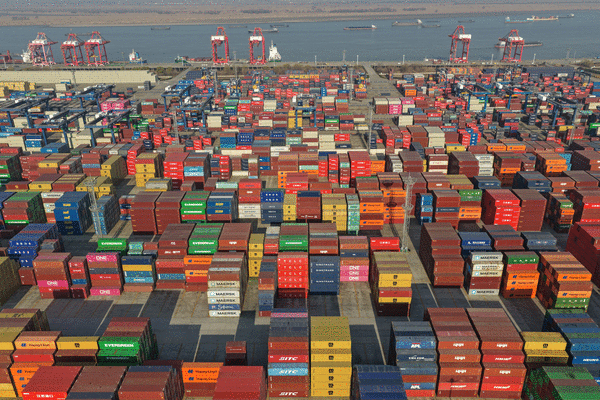
The U.S. government’s trade lawyers are working overtime. So what if the work in question requires more imagination than it does expertise?
Over the past fortnight, investigations into 16 countries for supposed manufacturing “excess capacity” have been launched under Section 301 of the 1974 Trade Act. The office of U.S. Trade Representative Jamieson Greer also announced that similar probes would begin into forced labor practices in 60 countries. Several of America’s largest trading partners, including the European Union, Japan, India and Mexico, will be on both lists.
One can safely assume that these 76 inquiries will proceed at a somewhat speedier rate than is usual, and the answers will arrive with the same breathtaking rapidity at which the questions were asked. An even safer assumption is that these answers will just happen to be the ones that the Trump administration wants.
The White House is moving with commendable efficiency here, as it tends to do whenever it sets out to destroy institutions. Section 301 investigations serve a real purpose — identifying countries that are deliberately setting out to violate trading norms — and generally take months. Their purpose was to remove trade barriers, not raise them. It’s perverse to employ them as post-hoc scaffolding for a policy that’s already been declared unconstitutional.
The entire world can see what’s going on. Everyone knew that President Donald Trump’s response to the Supreme Court striking down his tariffs under the International Emergency Economic Powers Act would be to find another law that lets him do exactly what he was just forbidden from doing. “No” has never been Trump’s favorite word, and if there’s one skill that a certain sort of real-estate developer perfects, its forum-shopping.
The list of countries is a bit of a giveaway that this entire process is a legal fiction. Picture an army of worthy USTR officials solemnly poring over Bangladesh’s structural overcapacity in manufacturing with all the seriousness of purpose that the exercise demands. Then imagine them turning with equal care to cataloguing the forced-labor practices of Norway, one of the 60 countries being examined.
Hard though it might be, the rest of the world will have to take this seriously. It’s far from certain that the courts will ride to the rescue again.
Yes, the margin on the IEEPA ruling was 6-3, and Chief Justice Roberts was quite emphatic. But Section 301 is different. It outlines a process that must be followed, and this investigation, however theatrical, checks off that procedural box. The world cannot assume that the justices will want to strike them down in toto again. The administration is counting on that; Greer has described these provisions as “incredibly legally durable.”
Washington has clearly learned something from its failures over the past year. Have its counterparts in the rest of the world learned anything from theirs?
First, is it safe to negotiate with Trump? As the European Union has found out, he will relitigate his own deals even when he isn’t being forced to by the Supreme Court. What the Section 301 investigations do is reopen — implicitly, perhaps explicitly — every deal Trump’s done so far, whether with Korea, Japan, India, or Southeast Asia. Must they go through the whole thing again? Can they?
Some, like Malaysia’s trade minister, think they will. The bilateral Agreement on Reciprocal Trade that Trump signed with Prime Minister Anwar Ibrahim to considerable fanfare at the ASEAN Summit last year is “null and void,” the trade minister said: “It is not on hold. It is no longer there.” The deal was as dead as Monty Python’s parrot. It has ceased to be. Why should any country consider itself bound by agreements signed under coercive terms that a court has voided?
Over the past year, countries rushed to secure piecemeal deals; some allowed panic to overtake them; very few coordinated their actions or retaliations. Washington’s pretense at investigations does at least give the rest of the world time to consider whether that was the best approach to take.
The worst part, of course, is that like all Trump’s actions on trade, there is only one objective target. Only one country has enormous manufacturing overcapacity; only one large exporting economy has a structural problem with forced labor. But somehow Trump is too weak to take on China armed with fact, but strong enough to take on the entire world with fiction.
Using a more defensible, granular statute means there are many more points of weakness than there were with the original “reciprocal” tariffs. Each application of Section 301 should be tested in the courts; every target of tariffs should talk to the others about what it has learned; the House, if the balance of power shifts after midterms, will have to hold the USTR to account.
Nudging the U.S. away from imagination and toward reality will not be an easy process. But it will have to be tried.
____
This column reflects the personal views of the author and does not necessarily reflect the opinion of the editorial board or Bloomberg LP and its owners.
Mihir Sharma is a Bloomberg Opinion columnist. A senior fellow at the Observer Research Foundation in New Delhi, he is author of “Restart: The Last Chance for the Indian Economy.”
©2026 Bloomberg L.P. Visit bloomberg.com/opinion. Distributed by Tribune Content Agency, LLC.










































Comments