Commentary: Tax season is here, but Americans are paying the debt bill in other ways, too
Published in Op Eds
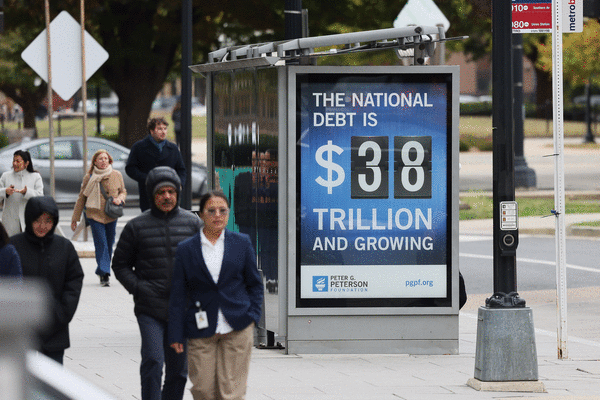
It’s tax season, and millions of American households are settling last year’s bill — but a much larger one is coming. For all the conversations taking place about trillions of dollars in accumulating government debt, we rarely talk about how the costs show up in everyday life.
Sometimes, this new tax bill shows up through future tax hikes (and I don’t mean the ones being proposed lately on millionaires or billionaires). Sometimes, it’s disguised as lackluster pay or high interest rates. Some of it is already baked into our personal finances, helping explain why so many Americans sense that something is off — that working harder doesn’t pay off like it used to.
Start with the taxes that support Social Security and Medicare, whose trust funds will be depleted in about six years. Under current law, if benefits aren’t cut, this will require higher taxes. Payroll taxes would rise by about 4.8 percentage points (roughly 4.3 points for Social Security and 0.5 for Medicare’s hospital insurance program).
This tax hike is technically split between employers and employees, but in practice falls mostly on workers. They immediately lose 2.4% of their earnings and, as employers pass their share back via lower wages or smaller raises over time, indirectly pay much of the other 2.4%.
For households already stretched thin, that’s not a small change. And it’s only part of the story.
Medicare is also funded by a 0.9% surtax on earnings and a 3.8% tax on investment income, supposedly targeting high earners. However, the cutoff point is not indexed to inflation or wage growth. So, every year, more workers are pulled in automatically — not because Congress voted to raise taxes, but because people’s earnings generally grow over time (even when our wages don’t keep up with the cost of living).
Medicare’s Trustees acknowledge this. Median household income has grown by almost 4% per year over the past decade, and by my calculations, more than 50% of households will be paying the taxes within three decades.
This is how “taxes on the rich” become taxes on middle-class families.
Put all of it together, and millions of Americans workers stand to lose up to 9.5% of their earnings through statutory marginal tax rate increases. It won’t apply evenly to every dollar or phase in all at once. What matters is the “marginal wedge”: how much of each additional dollar you actually keep.
Higher-income households can adjust, save less, reshuffle portfolios and hire accountants. Households living paycheck to paycheck don’t have those options. For them, it’s another steady squeeze on upward mobility, the ability to save or the financial cushion they use to absorb shocks. It’s one more roadblock to getting ahead.
Consider a teacher, nurse or mid-career office employee earning around $83,000 a year. Depending on the state they live in, each extra dollar they earn is already taxed at a marginal rate of roughly 32 to 39 cents (through combined federal income taxes, payroll taxes and state taxes). Social Security and Medicare insolvency combined with tax-bracket creep could increase that burden to roughly 39 to 46 cents.
That’s just what we can see. High payroll taxes reduce take-home pay in other, less direct, ways. It does this through insufficient wage growth — raises that barely matter, paltry overtime hours or side income that can’t keep up with expenses. Or through fewer benefits or fewer jobs altogether. The losses can’t all be seen in a line item on a pay stub; sometimes, the income just never materializes.
At the same time, high public debt contributes to higher interest rates. More government borrowing means we all face more competition for loan dollars, driving up the cost of credit. We feel it when buying a new family car or home. Businesses feel it too, which can lead to less expansion or hiring. The result is another drag on the wage growth that we need to keep pace with inflation.
Many people who are concerned about the debt fear a reckoning arriving all at once for some future generation. In the meantime, politicians continue to delay hard choices by imposing even more debt. In doing so, they put pressure on the system. When that pressure finally surfaces, it rarely comes in clean, transparent ways. It starts gradually, year after year, tightening financial constraints for people who are already struggling.
More debt issued today means higher tax bills tomorrow. Failing to fix Social Security and Medicare means the same thing. And for households already stretched thin, tomorrow isn’t far away.
____
Jack Salmon is a Gibbs Scholar and Research Fellow at the Mercatus Center at George Mason University.
___
©2026 Tribune Content Agency, LLC.




















































Comments