Federal health and environmental agencies to study microplastics and pharmaceuticals in drinking water
Published in Science & Technology News
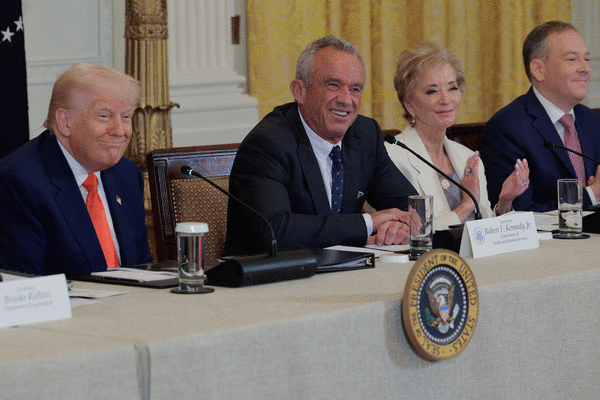
U.S. Secretary of Health and Human Services Robert F. Kennedy, Jr. and Environmental Protection Agency Administrator Lee Zeldin announced new initiatives to tackle microplastics in the human body and drinking water Thursday.
Kennedy said the government will create a new $144 million program called STOMP, for the systematic targeting of microplastics.
“We are focusing on three questions, what is in the body, what’s causing harm, and how do we remove it?” Kennedy said.
Zeldin said the the environmental agency will add microplastics and pharmaceuticals to its list of concerning chemicals in drinking water.
“For the first time in the program’s history, EPA is designating both microplastics and pharmaceuticals as priority contaminant groups,” he said.
The two cabinet members sat at a table in front of a crowded room at EPA headquarters in Washington, D.C. with microplastic researchers, including Marcus Ericsson, an environmental scientist and co founder of the anti-plastic Five Gyres Institute, Matthew Campin, a biomedical scientist at the University of New Mexico, and Leo Trasande, a pediatrician and public policy expert at New York University’s Grossman School of Medicine and Wagner School of Public Service.
On either side of the table were two large posters that said “Confronting Microplastics” in capital letters.
Zeldin had been under fire by the movement known as MAHA, for Make America Health Again, in recent months over federal plans to loosen restrictions on harmful chemicals, and approve new pesticides — including two that contain what are internationally recognized as “forever chemicals,” linked to serious health risks.
Kennedy, who is the political face of the MAHA movement, has also been criticized for capitulating on issues he once embraced. In February, Trump penned an executive order to shore up production of the herbicide glyphosate for “national security and defense reasons.”
Kennedy publicly supported the decision and in a social media post said that while herbicides and pesticides were “toxic by design” and “put Americans at risk,” the food supply depends on them.
Glyphosate, known commercially as Roundup, has long been a target of the MAHA movement. Produced by Bayer, which acquired the original manufacturer, Monsanto, in 2018, the herbicide has been the subject of tens of thousands of lawsuits, many from users who claim to have developed non-Hodgkins lymphoma as result of exposure.
Anti-plastic advocates applauded Thursday’s announcement.
“The U.S. Environmental Protection Agency has taken an important first step to regulate microplastics in drinking water,” said Judith Enck, a former regional director of that agency, and the founder of Beyond Plastics, an anti-plastic waste environmental group based in Bennington, Vermont. She urged the regulators to “move rapidly,” not only to regulate the plastic in drinking water, but also prevent it from getting into drinking water.
So, too did Kimberly Wise White, vice president of regulatory and scientific affairs at the American Chemistry Council, the trade group for the chemical industry.
“We support science-driven monitoring of microplastics in drinking water and research to better understand potential impacts,” said White in a statement.
Others, however, seemed dubious.
There is reason to be concerned about microplastics in drinking water, said Erik Olson, strategic director of health for the Natural Resources Defense Council, “but the EPA’s actions speak louder than its words. The Trump EPA is trying to scrap key PFAS standards and just two weeks ago said it wouldn’t issue any new protections for toxins in drinking water. So, which is it?”
In 2022, California became the first government in the world to require microplastics testing for drinking water. The state has not yet begin reporting its results.
Blair Robertson, a spokesman for the State Water Resources Control Board, said regulators are “working on it and being very deliberate as they proceed and try to quantify how microplastics are impacting drinking water.”
A report was expected in 2025, but has not yet been issued.
Micro- and nano-plastics have been found everywhere that scientists have looked. They’ve been found in human organs and tissue, such as brains, livers, placentas and testicles. They’ve also been detected in blood, breast milk and even meconium — an infant’s first stool. In addition, they are prevalent throughout the environment — in alpine snow, deep sea sediment and drinking water.
On March 31, a coalition of MAHA groups associated with Kennedy Jr. sent a letter to Zeldin requesting the Trump administration halt permitting for new plastics plants and step up monitoring of microplastics in drinking water.
In December, Zeldin told MAHA groups he would include measures on plastics as part of the agency’s agenda, after several prominent MAHA groups called for him to be fired. They said he was too close to chemical companies.
_____
©2026 Los Angeles Times. Visit at latimes.com. Distributed by Tribune Content Agency, LLC.






Comments