NASA astronauts bound for moon in landmark return mission
Published in Science & Technology News






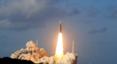



NASA’s four astronauts launched to space Wednesday, kicking off a landmark journey that will take them closer to the lunar surface than anyone has been in more than 50 years.
The crew’s Lockheed Martin Corp.-built Orion capsule, stacked on the shoulders of Boeing Co.’s Space Launch System rocket, thundered off the launchpad at 6:35 p.m. Eastern time at Kennedy Space Center in Florida.
The rocket system, taller than the Statue of Liberty, reached speeds of around 17,500 miles per hour as it hurtled to space, blazing a trail of fire and smoke as it climbed and eventually shedding its spent side boosters, which provided extra thrust.
Inside the capsule, the astronauts could be seen pressed into their seats in bright orange space suits. About eight minutes into the flight, SLS’ main engines shut down as expected and the capsule reached space.
“We have a beautiful moonrise. We’re headed right at it,” NASA astronaut and mission commander Reid Wiseman said during the live broadcast.
The mission is a crucial, in-space dress rehearsal for the long-delayed SLS rocket and Orion capsule, and marks the biggest milestone yet in NASA’s multiyear Artemis campaign to land humans on the moon as soon as 2028.
The four-person crew is set to travel farther in space than anyone in history.
The Artemis voyages will attempt to repeat and then leapfrog feats achieved during the historic Apollo program that landed Neil Armstrong and 11 other men on the lunar surface in the 1960s and 1970s.
Watch parties were planned across the country, including in major space hubs like Seattle, Houston and Huntsville, Alabama, where the core stage of the SLS is produced. Hundreds of thousands of viewers tuned into live feeds of the mission.
With Artemis — named after the twin goddess of Apollo — NASA aims to stay on the moon long term. President Donald Trump’s NASA administrator, Jared Isaacman, has laid out a decadelong $30 billion plan to set up a base on the moon where astronauts can live and work.
Isaacman has also sped through a significant makeover of the overall mission, including adding a test mission in 2027 that will send a crew to dock with one of the lunar landers being built by Elon Musk’s SpaceX and Jeff Bezos’ Blue Origin.
“We’re going to send them farther into space than any humans have gone before, 250,000 miles away,” Isaacman said minutes before the launch. “And it’s going to set up for the subsequent missions.”
About an hour before the launch, the space agency said it was troubleshooting a battery issue with the rocket, though it later cleared the issue.
The crew members will spend roughly four days traveling to the lunar vicinity, where they will swing behind the moon’s far side — a vantage that is never seen from Earth. They are slated to perform a flyby of the lunar surface on April 6.
If the mission unfolds as planned, their trajectory will take them within only roughly 4,112 miles (6,618 kilometers) of the moon during their closest approach, with the orb appearing about the size of a basketball in an outstretched hand in the capsule window.
Wiseman, a 27-year Navy veteran and former head of the agency’s astronaut office, is joined by NASA astronauts Victor Glover, the mission’s pilot, and Christina Koch, a mission specialist who conducted the first all-female spacewalk. Canadian astronaut Jeremy Hansen, another crew member, will be flying to space for the first time on this trip.
Roughly 3 1/2 hours after launch, Glover will steer Orion up close to a piece of the SLS rocket while in orbit, demonstrating the ability to closely approach another spacecraft. The same maneuvering will potentially be used to dock Orion with future lunar landers that will take astronauts down to the surface of the moon.
On the second day of the flight, the Orion spacecraft will ignite its main engine, sending the crew en route to the moon.
The U.S. is racing to get back to the moon before China sends its own astronauts there for the first time, a goal Beijing has set for before the end of the decade.
A number of U.S. China hawks, including U.S. Sen. Ted Cruz of Texas, have cast Artemis as a race for a strategic foothold in space, sometimes referred to as the “ultimate high ground” for war.
China has yet to send people to the lunar surface but has notched several achievements, including the only landings on the moon’s far side. The nation is also leading a project to build an international research station near the lunar south pole.
The Artemis II mission is notable for its numerous “firsts.” Koch will be the first woman to fly near the moon, while Glover will be the first Black astronaut to do the same. Hansen will also become the first Canadian to fly to the moon.
The mission marks just the second flight of the SLS rocket, which has fallen many years behind schedule. The rocket and Orion have suffered various schedule delays and cost overruns, which have pushed back the entire Artemis program.
U.S. Sen. Mark Kelly, of Arizona, embraced Isaacman’s new plans to build a moon base, but he also shared a dose of skepticism about NASA’s ability to land on the lunar surface in 2028.
“It’s going to be tough,” Kelly told reporters before crew members boarded the capsule. “I don’t think it’s out of the question.”
After the NASA crew fly by the moon, gravity will pull them back to Earth.
On the 10th day of the mission, their capsule will reenter the planet’s atmosphere and they will descend under parachutes and splash down in the Pacific Ocean.
A recovery ship and a team of divers with NASA and the U.S. Navy will meet up with the capsule to pull the crew out of the water.
_____
(With assistance from Julie Johnsson.)
©2026 Bloomberg L.P. Visit bloomberg.com. Distributed by Tribune Content Agency, LLC.






Comments