Invisible Weather: How We Dress for Temperatures That Don’t Exist
Published in Fashion Daily News
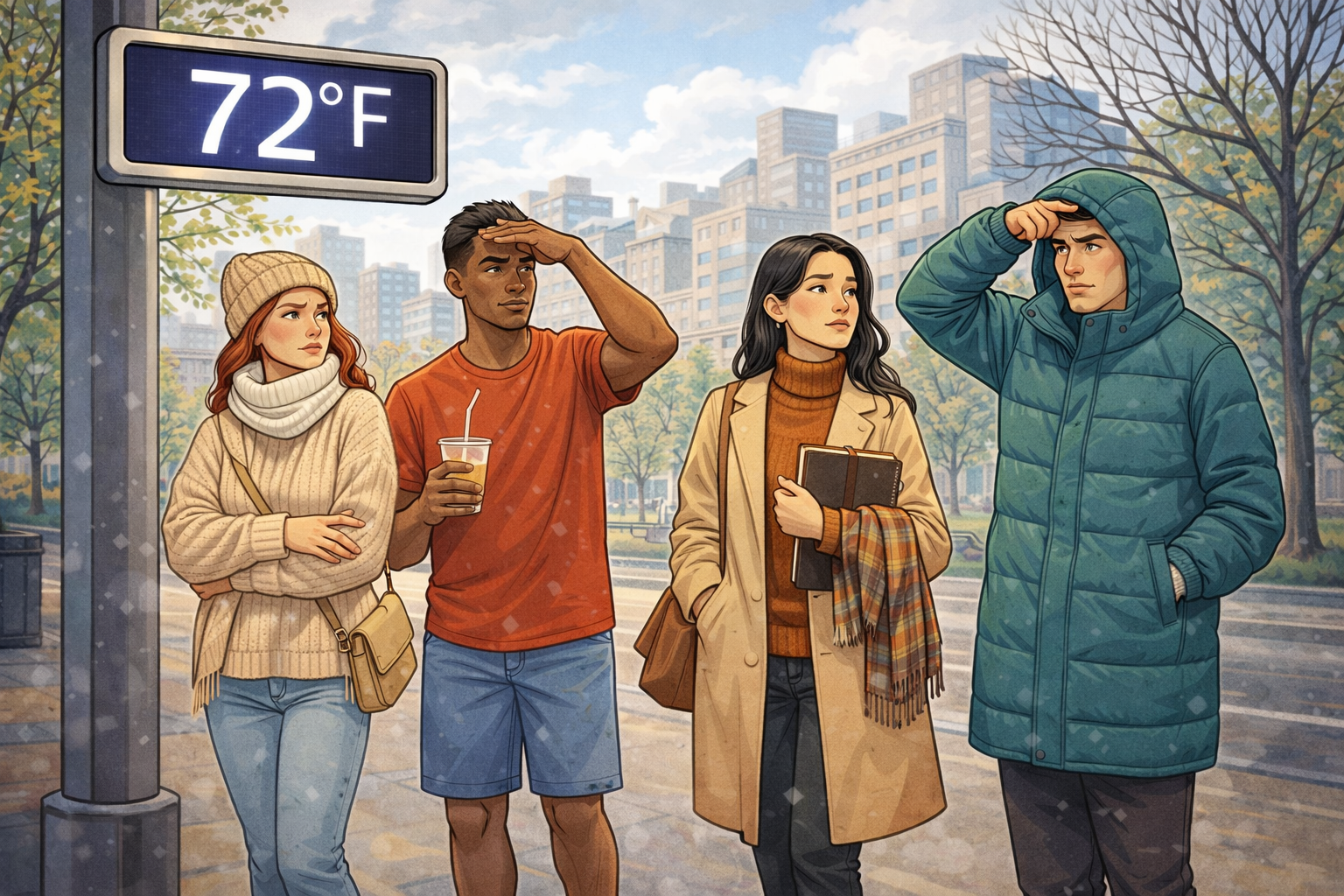
The woman standing on the subway platform is dressed for a crisp autumn morning: wool coat, scarf, ankle boots. It is 72 degrees.
Across the street, a man in a puffer jacket hurries past someone in shorts and a T-shirt. Both look equally certain they are dressed appropriately.
In cities and suburbs alike, people routinely dress for weather that does not quite exist — or at least not in the way they imagine it. Call it invisible weather: the set of expectations, habits and visual cues that shape what we wear, often more powerfully than the actual temperature.
The forecast in our heads
Weather, for most people, begins long before they step outside.
It starts with expectation. A calendar date, a season, a memory of how it “usually feels.” October suggests chill, even when it hasn’t arrived. April implies warmth, even when winter lingers.
These expectations are reinforced by culture. Retail displays shift weeks ahead of the actual climate. Catalogs show layered outfits in early fall and breezy linens before spring has fully settled in. Social media amplifies the effect, presenting an endless stream of outfits calibrated to an idealized version of the season.
By the time someone gets dressed, they are not responding to the air outside so much as to a narrative about it.
Dressing for the idea of a season
There is a certain satisfaction in aligning with the aesthetic of a season.
Scarves, boots and structured coats carry emotional weight. They signal transition, routine, even identity. To put them on is to participate in a shared rhythm, regardless of whether the temperature cooperates.
The same is true in warmer months. Sundresses, sandals and lightweight fabrics appear as soon as the calendar allows, sometimes well before the weather makes them practical.
This creates a subtle disconnect. People are not dressing for conditions; they are dressing for what the season is supposed to look like.
Indoor climates, outdoor assumptions
Modern life complicates the equation further.
Most daily routines involve moving between controlled indoor environments — homes, offices, stores — and brief periods outside. Air conditioning and central heating flatten the extremes, creating a kind of neutral baseline.
As a result, clothing often becomes a negotiation between imagined outdoor weather and very real indoor conditions.
A heavy sweater may feel appropriate for the season but becomes stifling in an overheated office. A light outfit may suit the indoors but leave someone shivering during a short walk.
Invisible weather thrives in this gap. People dress for a blend of environments that do not fully align with one another.
The influence of images
Fashion imagery plays a significant role in shaping these choices.
Advertisements and editorial spreads rarely reflect actual conditions. Models stand comfortably in layered outfits under clear skies, or pose in summer clothing without visible discomfort. The temperature in these images is implied, not real.
These visuals establish a standard. They suggest what a place or season should look like, and by extension, what people should wear within it.
In reality, few environments match these carefully constructed scenes. But the images linger, quietly guiding decisions.
Social cues and subtle pressure
Clothing is also a form of communication.
People look to one another for cues, consciously or not. If others are wearing coats, it can feel strange to go without one, even if the temperature does not justify it. If a room is filled with light, summery outfits, heavier clothing can feel out of place.
This creates a feedback loop. Individuals adjust to match the perceived norm, reinforcing it for others.
In this way, invisible weather becomes a collective experience. It is not just about personal preference, but about shared expectation.
When comfort loses the argument
One of the more curious aspects of invisible weather is how often comfort is sidelined.
People will tolerate being slightly too warm or slightly too cold in order to align with seasonal expectations or social cues. The discomfort is usually minor, but it is persistent.
A jacket carried but not worn. A scarf adjusted repeatedly. Sleeves pushed up, then pulled down again.
These small compromises are rarely questioned. They are simply part of getting dressed.
The role of habit
Over time, patterns form.
Someone who associates fall with layering may reach for a jacket automatically, even during an unseasonably warm stretch. Another person who expects summer to be hot may underdress on cooler days.
These habits simplify decision-making, but they also reduce responsiveness. The actual conditions become secondary to routine.
Breaking that pattern requires attention — a moment of pause to consider what the day truly feels like, rather than what it is supposed to feel like.
Relearning how to dress
There is a quiet skill in dressing for reality.
It involves noticing small details: the way the air feels on skin, the difference between shade and sunlight, the duration of time spent outdoors versus indoors.
It may mean carrying a layer rather than committing to one. Choosing fabrics that adapt, rather than outfits that signal. Letting go of the idea that clothing must match a seasonal image.
This approach does not reject style. It simply grounds it.
Why invisible weather persists
Despite its inconsistencies, invisible weather is unlikely to disappear.
It is woven into how people think about time, place and identity. Seasons are not just meteorological; they are cultural. Clothing is one of the ways those meanings are expressed.
To dress purely for function would strip away some of that expression. The appeal of seasonal style lies partly in its symbolism, even when it conflicts with reality.
A small shift in awareness
The goal, then, is not to eliminate invisible weather, but to recognize it.
To understand that the outfit chosen in the morning is influenced by more than the temperature outside. That expectation, imagery and habit all play a role.
With that awareness, the balance can shift slightly.
A lighter coat on a warm fall day. A sweater added on a cool summer evening. A willingness to adjust, rather than adhere.
In the end, dressing well may have less to do with matching the season than with paying attention to the moment — the actual air, the actual light, the actual experience of being there.
And that, unlike invisible weather, is something you can feel.
========
Leland Cross Merriweather is a freelance lifestyle writer who explores the intersection of culture, habit and everyday design. He lives in a city where the forecast and reality rarely agree. This article was written, in part, utilizing AI tools.






Comments