Scott Fowler: Dale Earnhardt Jr. knows all too well how poorly teenagers drive when distracted
Published in Auto Racing
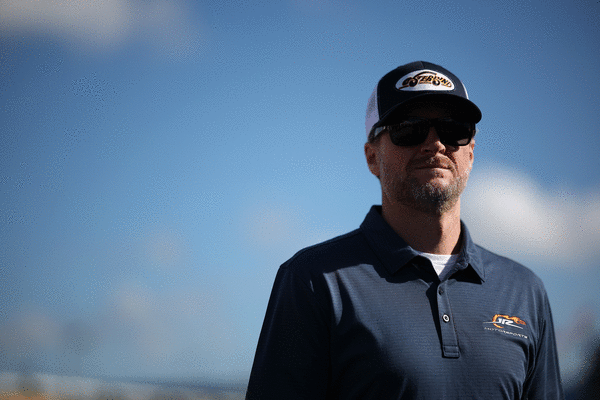
CHARLOTTE, N.C. — A long time ago, when Dale Earnhardt Jr. was a teenager and excited about driving his truck, he could have sworn he only looked down for a second.
It was Christmas morning. Dale Jr. was inside his Chevy S-10 pickup, which he dearly loved. And he now loved it even more, because his sister Kelley had just given him an adapter to allow him to play his CDs through the truck’s cassette player. This seemed like magical technology to Earnhardt, and he took his truck out for a spin to test it. Then he looked down to check on his music.
“I was fooling with that thing, and I drove off the road and flipped my truck,” Earnhardt said in our recent interview. “Dad (Dale Earnhardt Sr.) came and got me. It was just a mess. I got very lucky that I wasn’t hurt. But I think about myself, and how careless I was as a young driver. And that was 30 years ago, before we got cellphones.”
That’s why Earnhardt has teamed up with both Nationwide Insurance and a superb local organization called BRAKES to help teenage drivers become more focused and better able to handle difficult driving situations before they turn into crashes.
Nationwide has launched a free service that is available not only to its own customers, but to everyone. Through the Nationwide app on smartphones, any driver can sign up for its Focused Driving Rewards program, where you can earn points for distraction-free driving and redeem them for gift cards.
The program’s primary focus echoes Earnhardt’s message: Put the phone down.
Not that it’s easy to do. “Most of us can’t go much time at all without looking at them,” Earnhardt said.
Can Earnhardt, now age 51, stay away from touching his phone when he’s driving?
“For the most part, I’m pretty good,” Earnhardt said. “I talk to Siri. I plug my phone in, leave it down in the console and say, ‘Hey Siri, call so and so.’ So I’m hands free. But it is tempting. That’s human nature. That’s why we need programs like this to help us understand.”
That brings me to BRAKES. I’m a parent of four young adults and taught all of them to drive, so I understand what a white-knuckled roller coaster ride that can be.
But the best three hours I ever spent with any of my kids as a driving teacher was taking them to BRAKES and handing them over to an advanced driver’s education team that allowed them to practice the sorts of things that you normally never get to practice until you’re in a real crisis: like slamming on the brakes at 50 mph or how to steer a car when you’re in a full skid.
And you do this stuff in their cars too. And the parents get to take their turn and do a lot of it. I’m telling you, you can’t beat it.
Like many good ideas, BRAKES was born from tragedy. In 2008, drag racer Doug Herbert was in Phoenix, readying for a race, when he got the call that every parent dreads. It was a Saturday morning. Back home in the Lake Norman area, his 17-year-old son Jon was taking his younger brother, 12-year-old James, to McDonald’s for a biscuit — and driving way too fast.
At an estimated 80 mph, Jon lost control of his Mazda sports car, skidded across four lanes of traffic and hit a Hummer. The Hummer’s two passengers were also injured, though not seriously. But Jon and James Herbert died in the crash. Their car was a twisted hunk of metal, nearly unrecognizable.
Doug Herbert has told a version of that story hundreds of times over the past 18 years, reliving the worst day of his life in gritty detail to try and make the lives of other teenagers and their parents better. Not long after his sons’ deaths, Herbert began a small 501(c)(3) organization officially called “Put on the B.R.A.K.E.S.” (Be Responsible And Keep Everyone Safe). First, the idea was simply teaching Jon and James’ friends some advanced techniques for defensive driving.
Other parents heard about that and asked for Herbert and his small team of instructors to teach their kids, too. (This isn’t conventional driver’s education but is more advanced; a teenager must already have acquired a driver’s license or permit to take the 3-hour BRAKES course).
“Now we’ve taught over 160,000 people,” Herbert said in an interview. “And we originally were just so happy to train Jon and James’ friends.”
Classes are held around the country, using fleets of donated Kia cars and roughly 250 instructors, most of whom are current or former law enforcement personnel. In the Charlotte area, BRAKES sets up its classes at zMax Dragway in Concord roughly once a month and always fills up immediately — you have to go to the website to sign up. The classes are free, although a $99 deposit is required to hold the spot, and many parents by the end of the class are so grateful for the advanced education that they end up donating the $99 to BRAKES.
Anyway, that’s my plug. My kids still talk about what they did in the BRAKES class. They aren’t perfect drivers, but they all walked out of it as better ones.
As for Dale Jr., his two daughters are only 5 and 7.
“Oh, but they’re definitely going to BRAKES when they’re old enough,” Earnhardt said. “I’m a worrier by nature.”
BRAKES got involved in Nationwide’s campaign for focused, safer driving recently when it was asked to set up a course at zMax Dragway so that Earnhardt could instruct a local teen on the perils of various driving situations. I was invited to watch.
The teen was Allie Miller, a 17-year-old junior at Davie County High School in Mocksville. Roughly 90% of teen drivers will have at least a minor accident in their first three years, the BRAKES people tell you in their class, and Miller was no exception. “I did rear-end somebody last year,” Miller said.
But on this day, Miller glided through the BRAKES slalom course smoothly, with her phone out of reach and Earnhardt in the front seat. “It was a really cool experience,” she said afterward.
Was it difficult not to look at her phone?
“It is very hard nowadays, when everyone’s life is on their phone,” Miller said. “So it was very tempting, but I think it’s important to learn the consequences of it.”
Nationwide gave BRAKES a $10,000 donation at the end of the afternoon, so that was cool, too. As is Nationwide’s new Focused Driving app. As is the BRAKES program itself.
But whether you download that app or not, whether you have a teen driver and take that class or not, whether you’re a Dale Earnhardt Jr. fan or not, I beg you:
Put the phone down whenever you drive.
Whatever you’re tempted to look at?
It’s not worth your life.
©2026 The Charlotte Observer. Visit charlotteobserver.com. Distributed by Tribune Content Agency, LLC.






Comments