James Stavridis: US bases overseas are becoming prime targets
Published in Op Eds
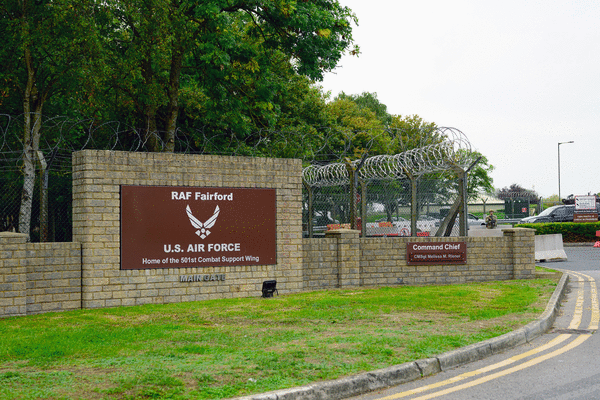
The Pentagon’s abrupt withdrawal of a dozen long-range B-1 bombers from a British airbase raises a host of troubling questions. Vice President J.D. Vance said the move was made “out of an abundance of caution” after U.S. and British officials reportedly received warnings of a potential drone attack ordered by Iran’s Islamic Revolutionary Guard Corps.
This naturally brings to mind Operation Spiderweb, the innovative Ukrainian strikes in June 2025 against Russian strategic bombers more than 1,000 miles from Kyiv. The Ukrainians moved their drones into Russia in trucks and then launched them with spectacular results.
The Iranians, like every other military power, are paying attention to what’s going on in the world’s other major theater of war. Tehran has also been striking U.S. military bases in the Middle East for months, causing significant damage, especially to the headquarters of the Navy’s Fifth Fleet in Bahrain.
How should the Pentagon prepare for this emerging threat against its global network of bases — even at locations once assumed to be safe havens such as Fairford in the UK?
The U.S. has roughly 750 military installations in more than 80 countries. These range from small communications-relay sites to massive installations such as Ramstein Air Base in Germany, which has a commissary and exchange complex so big we used to joke you could see it from space.
I grappled with the imperatives of force protection constantly while I was the supreme allied commander of the North Atlantic Treaty Organization more than a decade ago. Our biggest concern was that al-Qaeda and its affiliates would carry out relatively unsophisticated attacks with explosive-laden trucks or suicide bombers. We didn’t have to worry about high-tech drone attacks, but many of the principles of base protection are the same.
The Pentagon’s installations abroad are generally not regarded as U.S. territory; U.S. forces are typically guests on the host nation’s installation. The first step in countering today’s threats is reviewing the complex agreements governing relationships with host nations to ensure maximum safety and smooth interoperation — and renegotiating those that don’t. The 1983 bombings of the U.S. Marine barracks in Beirut, which killed nearly 300 U.S. and French troops, showed what can go wrong in a fractured and uncertain host-nation environment.
A second priority is sharing intelligence with the host nation. Information provided by the UK was probably behind the decision to pull the B-1 Lancers out. But intelligence-sharing between host and guest is often inconsistent, and channels of communication can be unclear. Given rising global risks, the two-way flow of information on any serious threat should go beyond the local commanders and to the top of the intelligence ladders in both countries.
Again, history has a deadly lesson: The Khobar Towers bombing in Saudi Arabia in 1996, in which more than 19 people were killed and 400 injured, was partly the result of poor intelligence cooperation between the Saudi government and local U.S. Air Force commanders.
A third priority is the physical security around, over and even under each base. Ordinarily, the host nation has the lead on external security arrangements. But we should encourage joint efforts to strengthen perimeter barriers and other defenses. The Pentagon needs to undertake a top-to-bottom review of all its bases for protection against unmanned technologies: aerial drones in particular, but also surface, tunneling and maritime platforms. This should start with bases in countries closest to Russia, Iran and North Korea.
Any review of U.S. bases should also include studying their power supplies, water sources, IT infrastructure and command-and-control nodes. While you can see why an audacious drone attack on B-1 bombers would appeal to the Iranians, Russia is more likely to use its cyberwarfare capabilities in less dramatic but more effective ways against huge U.S. bases in Europe like Ramstein.
Another step could be based on the Phoenix Ravens, highly trained Air Force personnel designated as “flyaway security” to protect high-value aircraft overseas. They typically travel on cargo and personnel flights, conduct airfield assessments and work with local security teams. Expanding this elite group’s numbers — fewer than 3,000 service members have earned the designation — and developing similar forces for the other services would be a smart move.
While improving security at each installation is an urgent need, sometimes you can get safer by getting smaller. The Pentagon should conduct a review of its entire basing network with an eye toward cutting back where it may be redundant or especially vulnerable. In the Middle East and Europe there are probably locations where a downsized physical presence could make sense.
A worldwide web of bases has deep military value — it allows us to monitor threats, forward-position personnel and equipment, and forge links with local militaries in scores of countries. But it also creates a huge set of targets for our enemies. Pulling the B-1s out of Fairford was probably the right move — UK authorities have made seven arrests in their investigation. But the U.S. military needs better preparation to combat these threats before such drastic steps are required, even if this means shrinking that global footprint.
____
Stavridis is dean emeritus of the Fletcher School of Law and Diplomacy at Tufts University. He is on the boards of Aon, Fortinet and Ankura Consulting Group.
This column reflects the personal views of the author and does not necessarily reflect the opinion of the editorial board or Bloomberg LP and its owners.
James Stavridis is a Bloomberg Opinion columnist, a retired U.S. Navy admiral, former supreme allied commander of NATO, and vice chairman at Carlyle.
©2026 Bloomberg L.P. Visit bloomberg.com/opinion. Distributed by Tribune Content Agency, LLC.


















































Comments