The data center 'tsunami' has flooded Nevada. Are lawmakers too late to regulate?
Published in News & Features
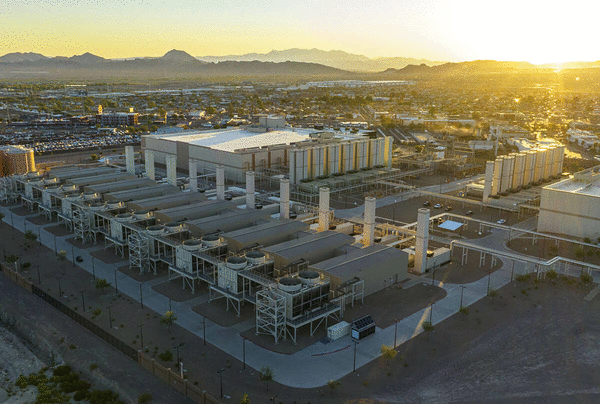
LAS VEGAS — The AI data center rush already has reached the nation’s driest state in a major way, but lawmakers are just now catching up on considering statewide regulations.
Nevada’s interim committees on natural resources and growth and infrastructure held a wide-reaching meeting Wednesday, when industry representatives, utility heads, researchers, tribal leaders and environmentalists provided information that could inform a bill in the 2027 session.
Energy and water demands from data centers remain the top two concerns in the absence of state laws to rein use in.
“At the end of the day, we need to be able to reassure our communities that there’s a certain standard moving forward,” said Assemblymember Howard Watts III, D-Las Vegas.
According to NV Energy’s 2024 integrated resource plan, accommodating 12 proposed data centers would increase the state’s energy load by nearly 50%, potentially making the state fall short of its legally mandated clean energy goals by 2030. The gaps in energy generation could be filled by natural gas plants instead, the utility has indicated.
Meanwhile, tech companies are asking smaller utilities, like the Lincoln County Power District No. 1 in rural Southern Nevada, for access to power that equates to 70 times its current peak load.
Northern Nevada is quickly becoming one of the country’s hot spots for data center construction, particularly within the Tahoe-Reno Industrial Center in Storey County.
Southern Nevada has its fair share of facilities, too, 10 of which consumed 352.6 million gallons of water last year with evaporative cooling, according to the Las Vegas Valley Water District. That’s enough water for 2,000 households for one full year.
A broad but somewhat unlikely coalition of Nevadans spoke up in support of more guardrails for data centers, including groups such as the Nevada Farm Bureau, the Toiyabe chapter of the Sierra Club and Mormon Women for Ethical Government.
“Data centers are coming like a tsunami to Nevada, especially Northern Nevada,” said Bari Levinson, a volunteer with the Sierra Club. “They are coming for a variety of reasons, including relatively inexpensive land, relatively inexpensive electricity and supposedly plenty of water, although I would take issue with this assumption.”
Not all data centers are created equal, and technology is rapidly advancing to use less resources.
Dan Diorio, of the national trade group called the Data Center Coalition, said so-called “closed loop” systems have been the norm for years and that most of the information circulating with the public assumes that all data centers will use old, evaporative cooling technology.
Diorio pointed to a 2024 study by the Virginia Legislature showing that 83% of data centers use about as much water as a large commercial office building, if not less.
“I think there are significant misperceptions that are happening because of the lack of contextual evidence for data centers,” Diorio said.
Southern Nevada implemented a ban on evaporative cooling in new development in 2024 that prohibits those traditional cooling technologies. That’s an important tool for water managers who are zeroed in on making sure that any water used in the Las Vegas Valley can be recycled and sent back to Lake Mead, the region’s main water source.
John Entsminger, general manager of the Southern Nevada Water Authority, said that since that took effect, tech companies have proposed several data centers that use closed-loop cooling with near-zero water footprints.
“We’re seeing a lot of plans for data centers, and that’s fine,” Entsminger said. “They can be built without consuming any more water.”
Both Watts, the Las Vegas assemblymember, and Pyramid Lake Paiute Tribe Chair Steven Wadsworth suggested that the Southern Nevada ban could be a model for statewide policy.
NV Energy will submit an updated integrated resource plan to the Public Utilities Commission of Nevada this year. The document is all but certain to show a slew of requests that the utility has received for large-load power connections since 2024.
According to an analysis from the advocacy group Western Resource Advocates, pending connection requests could ask NV Energy to quadruple its current capacity in its 2026 plan. Stacy Tellinghuisen, the organization’s deputy director of policy development, said it’s almost certain some of those projects won’t end up being built.
“We know that a hefty portion are probably speculative, because these data centers put in their names into the queues in multiple different utility systems at once as they’re working to figure out where the most economic location is,” Tellinghuisen said.
Diorio, of the Data Center Coalition, said some utilities have implemented “large-load tariffs,” or specialized fees attached to the largest users of power. In a few case studies, Diorio said, rates actually have been reduced for everyday consumers with added revenue.
“A well-structured, large-load tariff provides utilities the certainty that they need to ensure projects come to fruition,” Diorio said. “They can build infrastructure, and ultimately, they can ensure costs are allocated. And it also provides data centers visibility into what the rules of the roads are going to be.”
Agreements with tech companies could include a clean energy component, as well, such as Google’s partnership with geothermal company Fervo and NV Energy. Google helped fund the addition of 115 mega-watts of geothermal energy to the NV Energy grid while supporting the company’s data centers.
Shawn Elicegui, NV Energy’s senior vice president of regulatory and resource planning, said the company’s priority going forward is to strike a balance between inviting development while protecting the state’s low energy rates.
“While we stand ready to serve growth, we cannot do so at the expense of affordability or reliability,” Elicegui said.
_____
©2026 Las Vegas Review-Journal. Visit reviewjournal.com.. Distributed by Tribune Content Agency, LLC.





Comments