Bipartisan anti-fraud legislation inches forward in Minnesota after weeks without progress
Published in News & Features
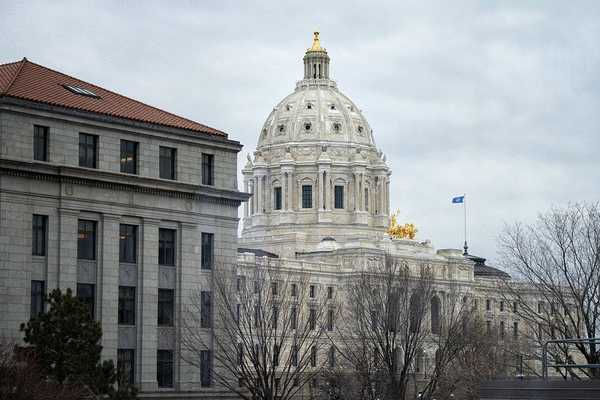
Minnesota lawmakers have struck a tenuous agreement to keep a flagship anti-fraud bill alive after a weekslong standoff.
Leaders of both parties in the Minnesota House and Senate say they want the legislation to establish an independent inspector general to investigate fraud in state programs. But it’s been stuck in negotiations over the details, leading to bitter floor fights and accusations from Republicans that Democrats are trying to kill the bill.
A divided House committee voted March 24 to move the bill along while legislators work out the kinks, but their challenge to agree on an idea that both parties support shows how difficult it could be for lawmakers to make progress on fighting fraud this year.
Sen. Heather Gustafson, DFL-Vadnais Heights, sponsored the legislation in the Senate, where it passed in 2025 with a wide, bipartisan majority. She said the bill deserves to reach the House floor to be considered after it spent the first several weeks of the session stuck in committee.
“It’s not really about us. It’s about the people we represent,” Gustafson said. “A lot of people are really tired of us sort of fighting over this clause or this sentence or who gets credit.”
Minnesota is facing a Medicaid fraud problem, the scope of which is still not known. So far, more than a dozen people have been charged with stealing from Medicaid-funded services for young people with autism, seniors and Minnesotans with disabilities. Federal prosecutors have predicted the total money stolen could reach into the billions.
While lawmakers worked to combat fraud last year — tightening program requirements and giving state officials broader authority to shut off payments — it’s a banner issue for this legislative session before candidates hit the campaign trail.
In addition to establishing an independent inspector general, lawmakers are considering investing in modern IT software to help detect fraud and adding staff to the Attorney General’s Office, which prosecutes Medicaid fraud.
Rep. Patti Anderson, R-Dellwood, the lead Republican sponsor of the proposal, said despite the rocky start, she feels good about the prospects for the legislation to make it across the finish line.
“This should have happened a month ago, but I guess it takes a deadline to move things around here sometimes,” Anderson said.
Though both the Republican and DFL leadership of the Minnesota House have expressed support for establishing an inspector general office, the legislation became one of the first partisan clashes when lawmakers returned to St. Paul in February.
And they still haven’t resolved the underlying disagreement.
Rep. Matt Norris, DFL-Blaine, is sponsoring the bill in the House and has proposed removing a law enforcement office included in the version that passed the Senate last year. He has argued it would duplicate efforts already undertaken by the Minnesota Bureau of Criminal Apprehension. The bureau’s superintendent, Drew Evans, agrees.
But that’s a non-starter for Republicans, who have accused Norris of watering down the bill on behalf of Gov. Tim Walz. The governor has disputed that.
Anderson said that if there’s no law enforcement provision of the bill, “then it’s dead.”
The version that passed March 24 includes the law enforcement office, but Norris said he doesn’t see the bill as a “finished product.”
“I’ve made it clear that I’m not interested in rushing legislation through simply because of the politics of the moment,” Norris said in committee.
He wouldn’t say whether removing the law enforcement office was a must for House Democrats.
“What I keep encouraging everyone is to not draw any bright red lines; instead, let’s come to this with a problem-solving mindset,” Norris told the Minnesota Star Tribune.
Gustafson said the Senate is firm in its support for giving the office law enforcement powers.
Rep. Jim Nash, R-Waconia, noted a commission appointed by Walz discussed finding an alternative to Gustafson’s version of the bill.
Meeting notes from the governor’s Statewide Inspector General Coordinating Council — established last fall by Walz to “unify agency inspectors general” — say the council wanted to “find a workable solution that we can recommend vs. the Gustafson bill.”
“If you begin putting disparate pieces of information together, you see patterns,” Nash said earlier in March, referring to Walz’s commission and Norris’ amendment. “It can be quite clear that the House DFL is doing the governor’s bidding.”
Walz disputed that in earlier comments to the Star Tribune, saying he’d sign it as soon as legislators pass it. He said on March 24 that he hoped lawmakers stayed focused on it.
“I think we’re going to find out,” Walz said, “how serious Republicans are about fixing this rather than complaining about it.”
_____
Ryan Faircloth and Nathaniel Minor of the Minnesota Star Tribune contributed to this story.
_____
©2026 The Minnesota Star Tribune. Visit startribune.com. Distributed by Tribune Content Agency, LLC






Comments