Colorado inches closer to new AI regulations -- but agreement is anything but certain in Legislature
Published in News & Features
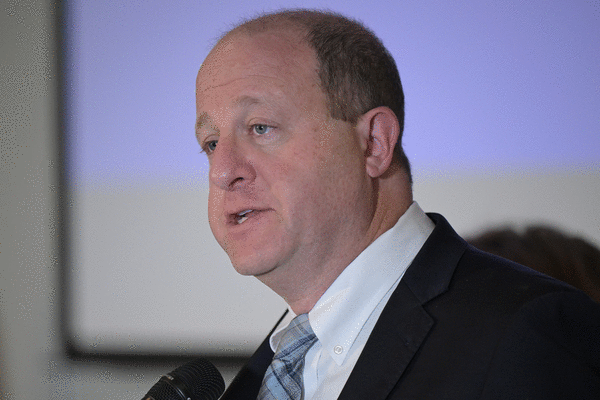
DENVER — A task force of consumer advocates and technology groups released a proposed framework to rewrite Colorado’s artificial intelligence regulations on Tuesday, setting off a renewed public debate on how to govern the new — and rapidly growing — technology.
The new proposal is the third attempt in two years to find agreement on how to regulate AI, and it’s the second involving a specially convened task force. Gov. Jared Polis signed Colorado’s first-in-the-nation regulations into law in 2024 under the broad understanding that those rules would serve as a cudgel to force some fine-tuning in years to come.
Without any legislative action this spring, those much-debated regulations would take effect in June as originally written.
The proposal unveiled Tuesday would leave it to the courts to decide liability between the developers of AI tools and the organization that used the tools for any discrimination attributed to the use of AI, based on the circumstances of the individual case. The covered AI technology would include any technology that processes personal information and engages in computation to make predictions, recommendations, rankings or other information that is used to guide or assist decision-making about an individual.
The proposed bill would focus on when AI is used to make “consequential decisions,” such as those involving education or employment opportunities, housing, financial or lending services, insurance, health care services and essential government services.
Consumer tools such as spell-check, calculators, spreadsheets, robocall filtering and large language models, such as ChatGPT, would not be affected.
“I am very grateful to the hardworking members of the Colorado AI Policy Working Group that have reached a unanimous agreement on AI policy to protect consumers and support innovation in our state,” Polis said in a statement. “I look forward to supporting the recommended framework as legislation moves through the process, and commend the Colorado AI Policy Work Group for their efforts to get us here.”
The framework must now be turned into legislation and wind its way through the meat grinder of lawmakers and lobbyists who weren’t involved in the task force’s deliberations.
Those dynamics sank the prior attempts at fine-tuning the regulations during the regular legislative session in 2025 and the special session later in the year. Competing interests fought over coverage and who would be liable for the misuse of AI technology to make so-called consequential decisions.
Lawmakers ultimately voted in August to delay the start time for the 2024 regulations to give themselves a third bite at the apple.
At the heart of the issue is the danger of AI being used, willingly or not, to discriminate against consumers. Earlier proposals failed as Polis worried that regulations that were too strict would kill the industry in Colorado or put the state at an economic disadvantage. Meanwhile, Senate Majority Leader Robert Rodriguez, a fellow Democrat, warned that having no regulations would hurt Coloradans and leave no recourse for misusing it.
Even now, uncertainty remains around how this latest shot will pan out, both inside the Capitol and outside. On Monday, the Washington Post reported that the Trump administration has been working with House Republicans to block state-level AI regulations as part of a package of federal legislation.
Though the framework was adopted by the group, nearly every participant also voted for “targeted revisions” to the draft — meaning that they wanted amendments. Each of those changes may be different and may rankle other members of the task force, and it’s unclear how any lingering tensions will be resolved.
The Colorado Technology Association was among the groups represented on the task force. President Brittany Morris Saunders said in a statement that the association was among those that voted yes, with an eye toward changes.
“We look forward to seeing this progress reflected in the forthcoming legislation and to continuing the dialogue on how to protect consumers while enabling innovation to thrive,” Morris Saunders said.
Even more unclear is how the framework will be received in the Capitol. While significant interests were involved in the task force, including the Colorado Chamber of Commerce and prominent consumer groups, it was, by design, a small, cloistered group.
About every international technology business, such as Amazon, Apple, Meta and Microsoft, has invested heavily in the technology, too.
Task force members said they had not established a process for shepherding the bill through the Legislature. Members, including Loren Furman, the president and CEO of the Colorado Chamber, said they wanted to try to keep the task force aligned as other interests or lawmakers proposed amendments and weighed in.
“As the legislative process unfolds, we’ll focus on ensuring the framework remains centered on consumers, functions effectively in practice and provides a foundation for adapting to future technology and emerging harms,” said Marissa Molina, the chief policy and communications officer for the Community Economic Defense Project and another task force member. She called the framework “real progress toward fairer technology accountability.”
That would offer at least something of a unified front — while defending the tenuously negotiated framework.
The framework “isn’t a completely finished product,” Furman said. “We’re still getting some revisions coming in, and we’re hoping this stays as intact as it can be as it hits the Legislature. But as you and I know, people have opinions in the Legislature.”
“It will be interesting to see how the task force can stick together and oversee the draft in its current form,” said Anaya Robinson of the American Civil Liberties Union of Colorado, who sat on the task force. The process from here, he said, “is clear as mud.”
Adam Burrows, a co-founder of Range Ventures and member of the task force, praised the proposal as finding a solid balance between what consumer groups felt they needed and what would still allow the business community — particularly small and medium-sized businesses — to flourish.
He said he was one of the few to vote for the framework as is. But more importantly, the framework represents a vast improvement over the 2024 law, which passed as Senate Bill 205, he said.
That law is stocked with reporting requirements and broad definitions that Burrows called “massive, unnecessary and pointless burdens on businesses.”
His Denver-based firm works with dozens of companies, many of which are in Colorado. All would have been affected by SB-205 going into effect, he said. This proposal would clean up definitions and give clearer guidance, he said.
“This is much more specific — much more surgical — with the protections that consumer groups felt were really needed … and then making it workable for businesses,” Burrows said in an interview. “I feel really proud of what the group came up with.”
It’s not totally clear who will sponsor the bill that’s eventually drafted from the framework, though Rodriguez has made clear he intends to be involved. He has held a tight grip on previous proposals, including stacking committees to get his preferred votes and voluntarily killing his own bill when it became clear that other forces would make changes he didn’t like.
Rodriguez had not yet reviewed the draft proposal and declined to comment through a spokeswoman on Tuesday.
The task force had worked through several iterations of its framework, and a final vote was delayed repeatedly as its members navigated late issues, including the question of whether to fully carve out hospitals and the insurance industry from being subject to the proposal. Furman said discussions around other areas of the policy continued into Monday night, dragging on to the point where she suggested another delay.
_____
©2026 MediaNews Group, Inc. Visit at denverpost.com. Distributed by Tribune Content Agency, LLC.





Comments